


Review: Gail Daughtry and the Celebrity Sex Pass

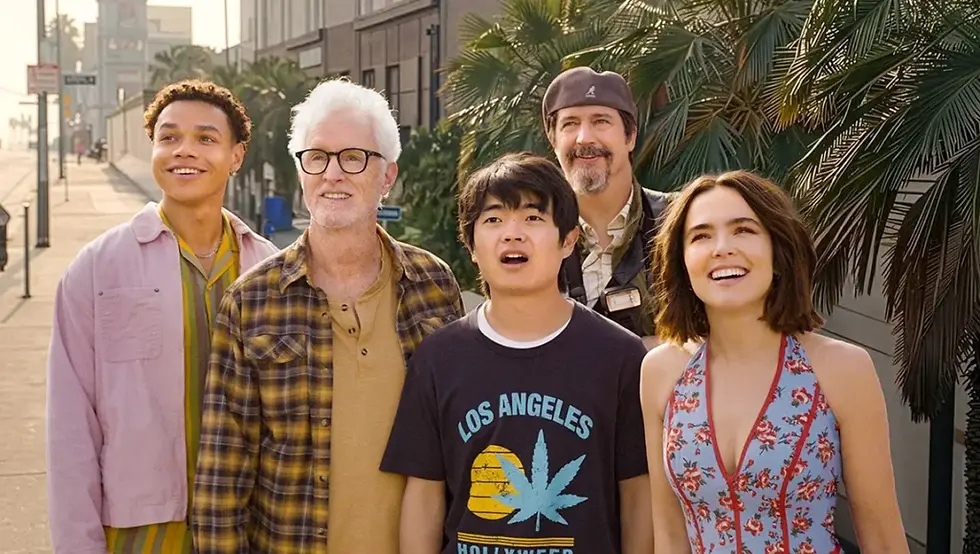
David Wain has built an entire career on asking audiences to accept one deeply ridiculous premise and then refusing to acknowledge that anything unusual is happening. His best comedies don't escalate because the characters become aware of the insanity around them; they escalate because everyone treats the absurd as perfectly ordinary. Gail Daughtry and the Celebrity Sex Pass follows that same philosophy, mining an inherently juvenile idea for every ounce of comic potential until it evolves into something resembling a live-action Looney Tunes cartoon.
The premise, a woman embarking on an increasingly impossible quest to cash in her own celebrity hall pass after her fiancé unexpectedly cashes in his, is almost beside the point. Wain isn't interested in the logistics or morality of the scenario. He's interested in seeing how many bizarre detours, celebrity self-own jokes, visual gags, and escalating misunderstandings he can string together before the audience catches its breath.
The answer, thankfully, is quite a few.
Like Wain's best work, the film operates on dream logic. Characters appear exactly when a joke needs them. Conversations take hard left turns into complete nonsense. Running gags are repeated long past the point where they should stop being funny, only to become funnier because of their sheer persistence. One minute the film is parodying celebrity worship, the next it's turning an innocuous roadside encounter into an elaborate comic set piece, then suddenly introducing another famous face willing to gleefully dismantle their carefully cultivated public image. Wain has always understood that celebrity cameos work best when the celebrity is the punchline rather than simply delivering one.
Not every gag connects. Some sketches feel like first drafts that never found a stronger ending, and the film occasionally mistakes randomness for escalation. But its batting average remains surprisingly high because of its infectious confidence. Even when a joke falls flat, another arrives thirty seconds later with enough energy to erase the memory of the previous miss.
Zoey Deutch proves, once again, that she's one of the finest comic actors of her generation. She possesses the rare ability to anchor utter nonsense through complete emotional sincerity. Gail never behaves like she's inside a spoof. Every setback feels devastating. Every new clue feels monumental. Every increasingly irrational decision is made with unwavering conviction. Deutch understands the oldest rule in comedy: if the lead believes every word she's saying, the audience will happily follow her anywhere.
Jon Hamm, meanwhile, continues one of Hollywood's funniest second acts. Few actors of his stature seem as eager to puncture their own mystique, and Hamm leans into the joke with effortless charm, proving once again that his greatest comic weapon is his willingness to appear vain, awkward, and just a little pathetic.
Then there's John Slattery, who nearly steals the movie outright. Slattery has always excelled at portraying polished authority figures with dry wit and impeccable timing, which makes his performance here all the more delightful. He barrels into the film with the manic energy of someone who's wandered in from an entirely different comedy, delivering every line with absolute conviction while becoming progressively more detached from reality. It's a fearless, gloriously unhinged performance that consistently pushes scenes into even stranger territory without ever feeling like he's chasing laughs. Whenever Slattery appears, the movie finds another gear.
The film's biggest weakness is that its satirical ambitions never quite match its comic instincts. It gestures toward celebrity culture, parasocial obsession, modern relationships, and our tendency to mythologize fame, but those ideas remain mostly window dressing. Wain seems less interested in dissecting celebrity than exploiting its inherent ridiculousness, which is often enough for a laugh but leaves the movie feeling lighter than it initially promises.
Fortunately, Gail Daughtry and the Celebrity Sex Pass rarely pretends to be anything more substantial. It's a joke machine, content to throw visual punchlines, awkward confrontations, escalating misunderstandings, and delightfully committed performances at the screen until something sticks. Most of it does.
David Wain remains one of the few American comedy directors still making films that feel genuinely unpredictable. In an era where studio comedies are increasingly polished into four-quadrant inoffensiveness, Gail Daughtry and the Celebrity Sex Pass embraces weirdness for its own sake. It's messy, inconsistent, and occasionally exhausting, but it's also gleefully inventive. Even when the jokes miss, the film never loses its willingness to swing for something stranger, and that's a quality worth celebrating.
4/5


Comments