


Review: Mortal Kombat 2

For a franchise built on spinal extractions, acid vomit, and the phrase “Finish Him,” the most surprising thing about Mortal Kombat II is how desperately it wants to entertain you. Not impress you. Not elevate itself above its origins. Not apologize for being based on a game where a four-armed monster punches ninjas into skeletons. Simon McQuoid’s sequel understands that the appeal of Mortal Kombat has always lived somewhere between adolescent power fantasy and grindhouse absurdity, and for long stretches, the film embraces that with a kind of sweaty sincerity that makes it difficult not to grin at its excesses.
That alone puts it miles ahead of the dour, self-serious 2021 reboot.
The first film spent an exhausting amount of time treating its mythology like sacred text. It introduced a new protagonist nobody cared about, danced around the actual tournament audiences wanted to see, and often felt embarrassed by the pulpy insanity that made the games popular in the first place. Mortal Kombat II course-corrects almost immediately. The tournament is finally here. Shao Kahn looms over the proceedings like a professional wrestler trapped inside a Frank Frazetta painting. Heads explode, limbs detach, and characters speak in portentous nonsense with complete conviction. The movie is still dumb, often spectacularly so, but now it’s dumb in the right way, well, mostly. Most importantly, Karl Urban brings a much-needed levity to this sequel.
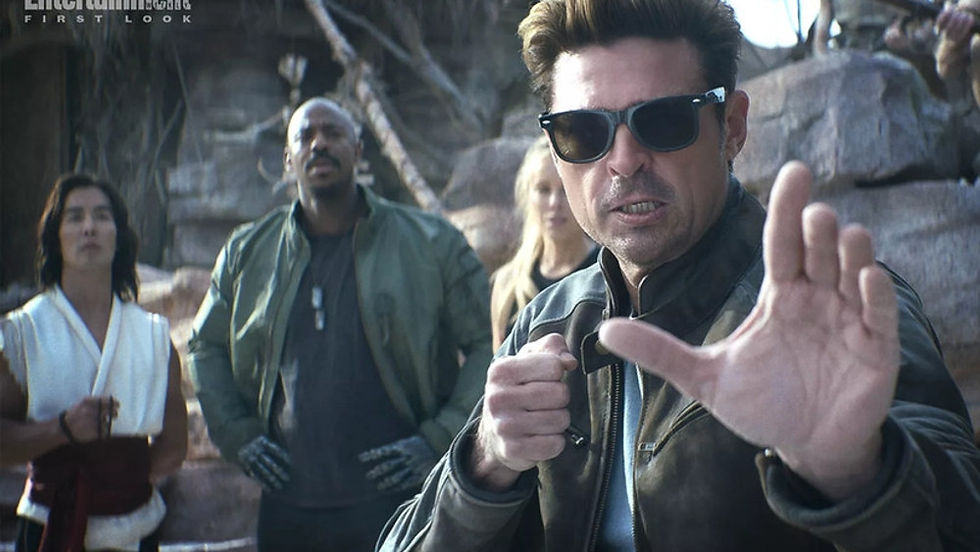
Urban’s Johnny Cage arrives as if he wandered in from a completely different movie, and somehow that becomes the film’s greatest strength. Playing Cage as a washed-up action star whose ego barely conceals deep insecurity, Urban gives the movie an anchor it badly needs. He understands the assignment better than anyone else onscreen. Rather than leaning entirely into parody, he plays Cage as a man desperately trying to convince himself he’s still the hero of his own story. It gives even the stupidest jokes a strange charm. Urban has always excelled at playing arrogant men haunted by vulnerability, and that quality helps give the film the slightest hint of emotional pull. Not that Mortal Kombat II suddenly becomes a character study.
The plot is essentially an excuse to move fighters between elaborate arenas so they can pulverize one another in increasingly grotesque ways. Shang Tsung schemes. Shao Kahn threatens Earthrealm. Scorpion glowers. Liu Kang looks noble. The screenplay, credited to Jeremy Slater, throws lore at the audience with reckless abandon, assuming viewers either already know who these people are or simply do not care. It becomes so convoluted that at times, it ruins the fun. The film is also needlessly long due to all of the plot mechanics. Too often, the film tells us the what and never the why, so it becomes difficult to care about all the exposition.
The choreography here is vastly improved from the previous film, which often edited around action rather than through it. McQuoid and his stunt team finally seem aware that martial arts sequences require rhythm, geography, and escalation. A brutal Johnny Cage-Baraka fight inside a ruined theater becomes one of the movie’s highlights, balancing slapstick comedy with genuinely impressive stunt work. Later, a confrontation involving Kitana and Shao Kahn injects a little emotional weight into the carnage, even if the movie only briefly earns it. The fatalities, meanwhile, are as ludicrous and crowd-pleasing as fans could hope for. One sequence involving a spine rip drew audible cheers from my audience, which may say troubling things about modern civilization but certainly says positive things about the movie.
Visually, the sequel also improves on the drab, empty look of its predecessor. The larger budget is evident immediately. Outworld occasionally looks like a real place, but often it looks like cheap sets. The production design embraces heavy-metal fantasy imagery with enough confidence that even the sillier costumes eventually start to work.
Still, for all its improvements, Mortal Kombat II remains frustratingly uneven. The pacing sags badly in the middle as the film juggles too many characters and side plots simultaneously. Lewis Tan’s Cole Young remains a charisma vacuum, and the movie never figures out why audiences should care about him when surrounded by infinitely more interesting personalities. Several returning characters exist largely to deliver exposition or set up inevitable sequels. And while the film’s humor works more often than before, there are still stretches where it mistakes constant quipping for actual wit. Demanding elegance from material like this misses the strange purity of what McQuoid and company are attempting. Mortal Kombat II succeeds not because it transcends its source material, but because it finally stops fighting against it. The movie embraces the inherent silliness of the franchise without turning everything into smug self-parody. I only wish it did this more evenly. Messy but fun, this is mostly for the fans, but I think casual audiences will find enough to enjoy.
3/5


Comments