


Review: Whalefall

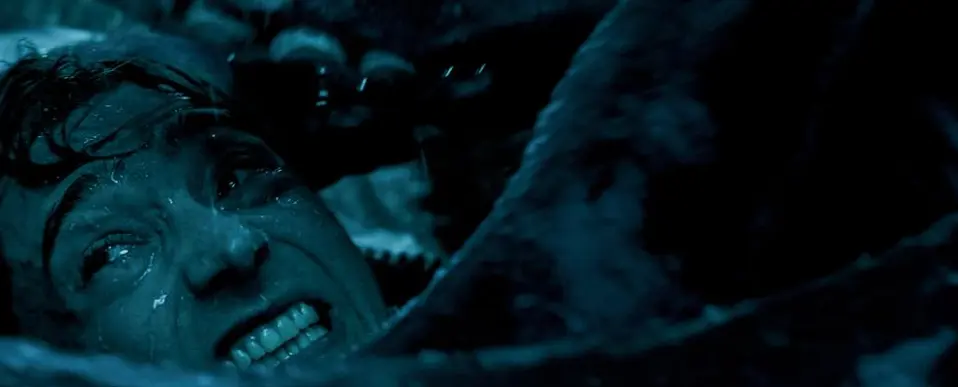
Brian Duffield’s Whalefall begins with the sort of premise that sounds like a dare made after midnight: put one grieving scuba diver inside a sperm whale and see how long an audience can hold its breath. It works by turning a biological nightmare into a bruised father-son drama without completely drowning in its own symbolism.
Austin Abrams plays Jay Gardiner, a man orbiting the death of his father, Mitt (Josh Brolin). A year after Mitt buries himself at sea, Jay dives off the California coast in search of his remains. A squid, a feeding whale, and one spectacularly bad turn of fortune leave him swallowed alive. With his oxygen dwindling, Jay must navigate an environment never intended to be navigated, using the lessons of the man he has spent much of his life trying not to become.
Duffield, adapting Daniel Kraus’ novel with the author, understands the chief attraction: we paid to go inside the whale. Its slick corridors pulse, contract, flood, and burn. Aaron Morton’s cinematography finds an eerie beauty in the darkness, lit by bioluminescent organisms and the sickly glow of Jay’s equipment. The effect is less like exploring a cave than trespassing inside something that can object.
The film’s best passages turn anatomy into an escape room. Jay takes inventory of whatever the whale has swallowed, testing scraps of sea waste against impossible problems while his air gauge keeps the clock. Duffield gives these sequences a blunt physicality. Abrams is scraped, soaked, crushed, and reminded that nature does not care about his character arc. The whale is not a villain. It is an ecosystem, a prison, and occasionally the world’s largest involuntary therapist.
That last function is where Whalefall becomes less steady. Flashbacks to Mitt interrupt the survival story, revealing a father whose hard-earned knowledge arrived wrapped in cruelty. Brolin gives him the authority of a man who mistakes toughness for love. He can teach a child how to breathe underwater but not how to feel safe on land. The idea is potent: the same voice that wounded Jay may be the one that guides him home. Yet the screenplay repeats it so insistently that metaphor starts to feel like another organ squeezing the life from the movie.
Still, Abrams holds the film together. He has the bruisable quality of someone apologetic for taking up space, which makes the ordeal feel vicious. Because much of the performance is trapped behind a mask, Abrams works through panic, posture, and breath. He makes Jay’s calculations readable without turning him into a survival genius. Even when the script asks him to narrate what we can see, his fear feels immediate rather than performed.
Pietro Scalia’s editing moves between the whale and Jay’s memories with mixed results. At times, sensation unlocks memory with force, and the past rushes in like water through a broken seal. Elsewhere, the flashbacks stall momentum as the physical danger becomes most gripping. Whalefall occasionally forgets that being digested alive is already a persuasive dramatic situation. It does not need every mouthful of peril translated into a lesson about grief.
Yet Duffield’s conviction to putting us in the whale carries the movie over its softest patches. He never smirks at the premise or apologizes for its emotional ambition. The textures, visual effects, and oppressive sound design create a place that feels impossible but tangible. Few films could make a discarded trash bag seem heroic or transform an oxygen readout into a countdown with this much force.
Whalefall is messy, harrowing, gruesome, and corny as all hell. Its family drama is more familiar than its setting, and the movie sometimes strains to make the whale mean everything at once: father, fate, grief, God, and nature’s indifference. It is most powerful when it lets the creature be a creature and allows Jay’s survival to carry its own meaning.
This is a film about escaping the body of something enormous while remaining trapped inside the memory of someone even larger. Duffield does not solve that contradiction so much as fight his way through it, never trusting the audience to get it. Every emotional beat is hit upon with such an obviousness. The result is uneven but hard to shake, a survival thriller with acid in its veins and a wounded heart beating somewhere beneath all that blubber.
3.5/5


Comments