


Ready or Not 2: Here I Come
- Matthew G. Robinson
- Mar 18
- 3 min read


To revisit the final image of Ready or Not, Samara Weaving, blood-soaked, dazed, and smoking in the wreckage of a burning mansion, is to be reminded of how rare it is for a horror-comedy to land on something that feels instantly iconic. It’s a closing note that doesn’t ask for expansion. It lingers. It resonates. It ends. Ready or Not2: Here I Come makes the fatal mistake of picking that image back up and asking, “But what if… more?”
And more is exactly what this sequel is, more characters, more mythology, more rules, more plot. A sequel with a capital S, the kind that confuses escalation with evolution. In trying to build outward, it loses sight of what made the original crackle: a simple premise, a sharp sense of tone, and, most importantly, Samara Weaving at the center of it all.
Weaving returns as Grace, and she remains the film’s most vital asset, a performer capable of conveying terror, fury, exhaustion, and defiance all at once, often in a single look. She’s still doing remarkable work here, still grounding the chaos in something human and reactive. But the film seems oddly uninterested in her. Instead of building around her experience, it buries her under an avalanche of new players and increasingly convoluted lore about a wider cabal of devil-worshipping elites.
It’s a strange trade-off: the more the film explains, the less compelling it becomes.
The expanded world introduces a rogues’ gallery of wealthy sadists, along with a rulebook that gets so dense it starts to feel like a card game you’re forced to learn mid-play. Elijah Wood pops in to lay out the mechanics with amusing precision, but the film can’t help itself, it keeps explaining, revising, and occasionally contradicting those rules as it goes. The result is something that feels both overdetermined and oddly slippery, as if the filmmakers are less interested in tension than in keeping the machine moving.
And move it does. The film is rarely still, cycling through chases, captures, reversals, and bursts of ultraviolence with a kind of breathless efficiency. There are sequences here that absolutely work, clever, kinetic, and often very funny. The kills remain a highlight, staged with a mix of splattery inventiveness and pitch-black humor that recalls the first film at its best. But they land with diminishing returns. What once felt shocking now feels expected, even routine.
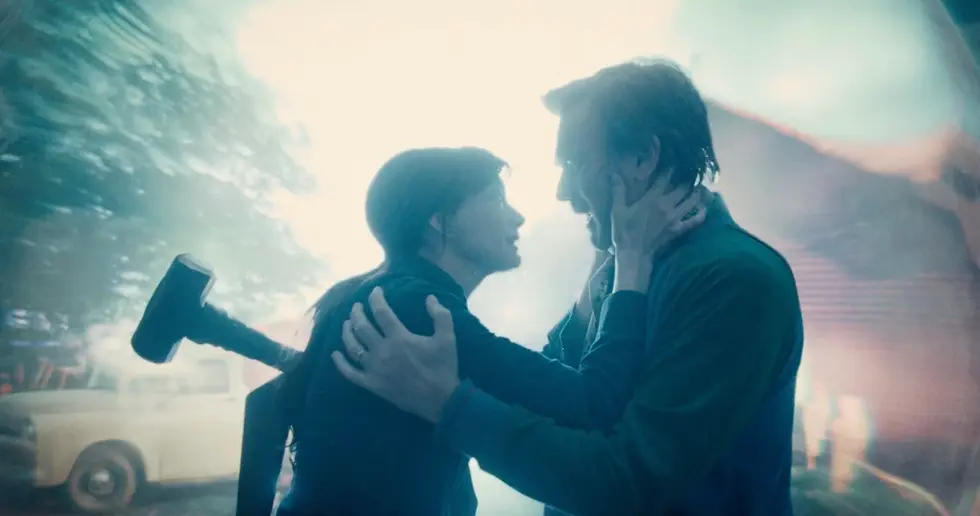
The most promising addition is Kathryn Newton as Faith, Grace’s estranged sister. Newton brings a welcome edge, sardonic, guarded, quietly wounded, and she shares an easy chemistry with Weaving. When the two are actually allowed to play off each other, the film briefly snaps into focus. There’s a better movie lurking in those moments, one that leans into their fractured relationship rather than treating it as narrative filler between set pieces.
Instead, their dynamic is underwritten and delayed, reduced to vague hints of past conflict that only surface when the script needs a breather. By the time they begin to function as a unit, the film has already spent too long spinning its wheels elsewhere.
That “elsewhere” includes subplots involving Sarah Michelle Gellar and Shawn Hatosy as a rival sibling duo, along with a sprawling ensemble of interchangeable elites who exist primarily to be dispatched. They’re broadly drawn, often cartoonish, and rarely memorable beyond a single defining trait. For a film so crowded with characters, it’s striking how few of them leave an impression.
There’s also a nagging sense of repetition hanging over everything. The central game is another variation on hide-and-seek and it feels less like a deliberate echo and more like a failure of imagination. The structure mirrors the original so closely that it begins to feel like a remix rather than a sequel, a bigger-budget version of something we’ve already seen executed with more clarity and energy. That’s the paradox at the heart of Here I Come: it’s larger in every way, but somehow smaller where it counts.
It’s not without its pleasures. It’s fast, frequently funny, and occasionally inspired in its nastiness. Audiences will likely have a good time in bursts. But the surprise is gone, the focus is diluted, and the film’s best element, Weaving’s singular presence, is too often pushed to the margins of her own story. Like a game that goes on too long, the thrill of not being caught eventually gives way to something else entirely: the quiet realization that you’d rather just be done.
2.5/5


Comments