


Review: The End of Oak Street

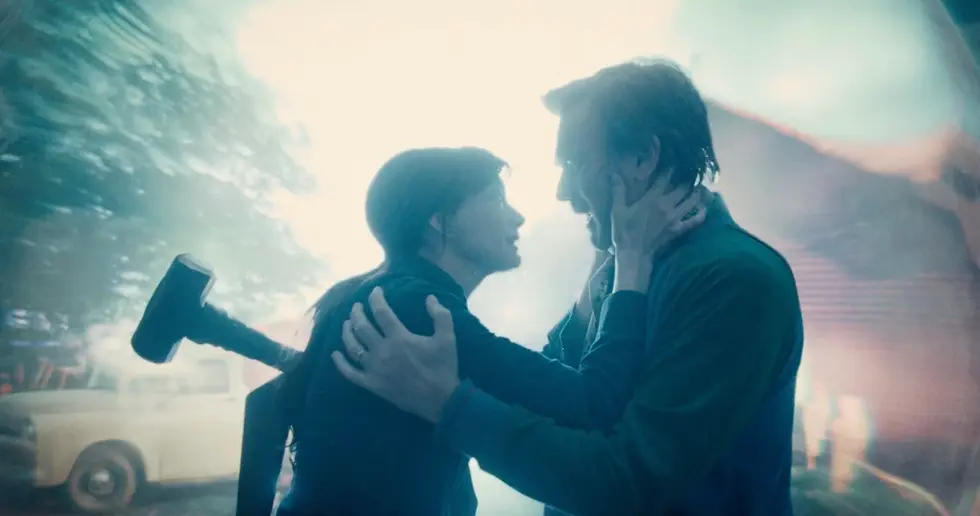
There’s something wonderfully strange about watching a family quietly fall apart while a dinosaur takes a dump on the neighbor’s lawn.
That particular collision of domestic malaise and prehistoric absurdity is where The End of Oak Street is at its best. Writer-director David Robert Mitchell has always been interested in familiar American spaces becoming subtly, inexplicably wrong. It Follows turned Detroit suburbs into an endless nightmare; Under the Silver Lake imagined Los Angeles as a conspiracy waiting to be decoded. Here, Mitchell sets his sights on the Amblin suburbia of Steven Spielberg, where unhappy parents, restless teenagers, bicycles, backyards and impossible creatures can coexist.
For about forty minutes, that combination is enormously promising.
Greg (Ewan McGregor) and Denise Platt (Anne Hathaway) live with teenagers Audrey (Maisy Stella) and Brian (Christian Convery) on an otherwise unremarkable suburban street. Their marriage is barely functioning. Greg has taken to secretly delivering pizzas after his career stalls, while Denise is writing a thinly veiled novel about a woman contemplating leaving her family. Their kids have problems of their own, none of which seem particularly important once the temperature suddenly spikes, prehistoric vegetation starts sprouting and something enormous begins prowling behind the fences.
Eventually, Oak Street finds itself displaced into a world populated by dinosaurs. It is a terrific premise, and Mitchell initially has fun withholding exactly what is happening. Michael Gioulakis’ camera turns ordinary suburban spaces into ominous compositions, while Mitchell understands the pleasure of seeing something impossible briefly intrude upon the mundane. Hathaway is especially good at grounding the weirdness, and Stella and Convery find some affecting moments together when the movie allows the teenagers to simply be frightened kids instead of pieces in its larger thematic machinery. The problem is that Mitchell seemingly cannot decide what that machinery is supposed to build.
The End of Oak Street keeps suggesting that what we are watching is allegorical. The dialogue can be deliberately arch. The coincidences are too precise. The Platts’ emotional problems seem conspicuously reflected by the increasingly bizarre world around them. Mitchell practically begs us to wonder what the dinosaurs mean.
That works in The Twilight Zone, where a fantastical premise can become an exaggerated representation of some recognizable human failing. Mitchell’s own It Follows operates similarly, turning its monster into something that can simultaneously suggest sex, mortality, trauma and the inevitability of adulthood without requiring one definitive interpretation. But The End of Oak Street ultimately wants something closer to E.T. That is a different kind of magic.
E.T. doesn’t need to represent divorce for Spielberg’s film to be about a child processing a broken family. The fantasy creates a space in which Elliott can experience love, loss and goodbye. Spielberg believes completely in both the alien and the boy, allowing metaphor to emerge from emotional truth.
Mitchell spends too much of Oak Street signaling metaphor and then asks us to accept its finale primarily as emotional truth. The dinosaurs gradually stop feeling like manifestations of something and become obstacles the Platts must survive so they can rediscover how much they love one another. By the time the movie reaches for its big, sincere Amblin catharsis, it hasn’t done enough work to make that reconciliation feel earned.
The adventure itself only partially compensates. There are clever creature encounters, some amusingly nasty dinosaur business and enough visual craftsmanship to remind us that Mitchell remains an interesting filmmaker. Michael Giacchino’s score enthusiastically pushes toward the Spielbergian wonder the movie wants to summon. Yet the danger strangely loses weight as the spectacle grows. A movie filled with enormous prehistoric predators rarely develops the breathless momentum its premise promises. Perhaps that is because the real question is never whether the Platts will survive. It is what surviving is supposed to teach them.
The End of Oak Street has plenty worth admiring: Hathaway’s committed performance, the teenage relationship, Gioulakis’ imagery and a first act filled with enticing strangeness. Even its failure is more interesting than another anonymous piece of franchise maintenance.
But Mitchell seems caught between two movies: an arch suburban allegory about a family whose repressed unhappiness becomes literally monstrous and an earnest adventure about extraordinary circumstances bringing ordinary people back together.
Either one could work.
At The End of Oak Street, they collide like two objects displaced from different eras.
2.5/5


Comments